
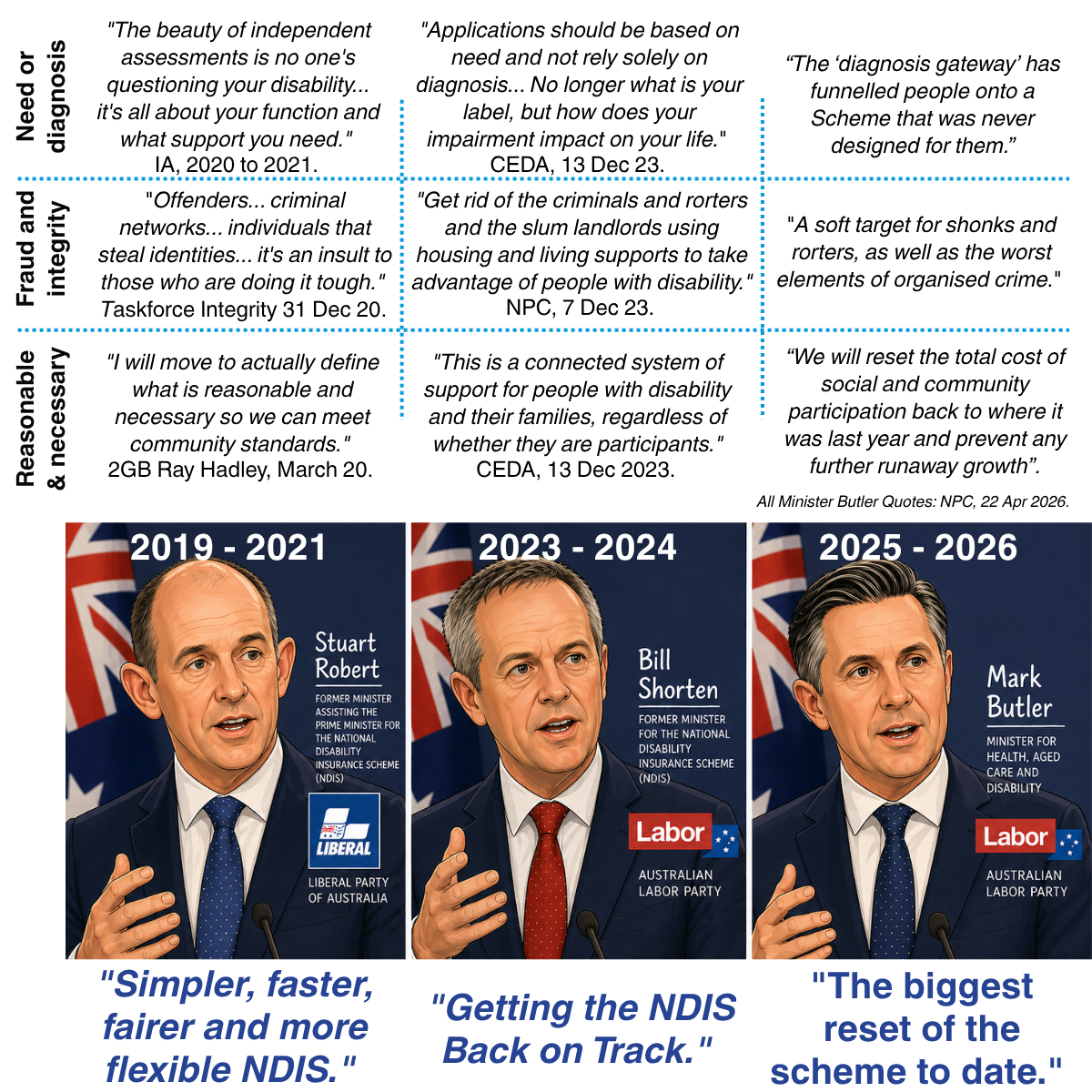
Modelling Minister Butler's reforms
Butler's 22 April announcement quietly transferred one question to every NDIS provider. Can you prove the support is necessary, proportionate, delivered, documented, and producing enough value to justify the cost?
When quality isn't defined, cost becomes the only thing left to control
Part two of a seven-part series on the 22 April NDIS reform announcement and what it is asking of providers.
Butler's reform agenda was delivered as "better quality through better design". Yet every initiative circles back to cost and control.
This may sound crazy, but I don't think the issue is actually money. The issue is understanding.
I've come to that conclusion because of the divergence in the last three years. In 2022/23 the average participant plan was $80,000 with average utilisation of 83%. In crude terms, that meant actual spend per participant was around $66,400. Today the average plan is $85,000 with utilisation at 75%, which is actual spend of about $63,750.
Plan values went up. Utilisation went down. Actual cost per participant landed slightly lower. I suspect the government cannot pinpoint why the average plan value has increased, nor why utilisation has decreased. They have simply worked out that they have a $15 billion dollar exposure on the trajectory.
Their response to not having clear line of sight between what is approved, what is delivered, and whether any of it was value for money is to build a big gate so they can see who is coming and going.
I'm pretty sure this was the defence tactic for the ancient city of Troy too. Impressive walls. A great gate. And the actual threat walked straight through it, gift-wrapped.
In part one I argued that the 22 April announcement is largely a re-announcement of agendas already set across the previous decade. Today we go deeper into the propositions and their history. None of this is genuinely new. Nor does it appear that any of the underlying problems have been addressed.
What has changed is who carries the weight. The government is silently transitioning the biggest question of the entire scheme to individual providers.
> "Can you prove the support is necessary, proportionate, delivered, documented, and producing enough value to justify the cost?"
That is the question every reform in the announcement is asking, even when it is not the question being announced. The rest of this piece walks through the twelve propositions in the order they answer it.
The goal driving all propositions: the 5% growth cap
The proposition is a numeric target. Spend grows at 5% rather than the current 10% trajectory. Butler said the NDIS would cost around $55 billion in 2030 instead of more than $70 billion, with average growth of about 2% over the forward estimates before returning to 5% from 2030.
The framing is not new. Cost-and-sustainability has been the dominant lens applied to the NDIS by every government since at least 2017. From 2018 to 2022, Prime Minister Morrison spoke of independent assessments as needed to keep the scheme sustainable and affordable. Minister Reynolds told Senate Estimates costs were rising "far more significantly, year on year, than was ever expected" and described the trajectory as "unsustainable over the longer term". The Coalition register through that period was sustainability and cost almost exclusively.
The sustainability framing carried into Labor with a different narrative but essentially the same target. On 6 December 2023, National Cabinet agreed an 8% growth target from 1 July 2026. Shorten restated it at the Committee for Economic Development of Australia on 13 December 2023, when he committed the scheme would "continue to grow by up to 8% from the 1st of July 2026, and mature over time". Butler has now tightened that to 5%.
The most alarming observation is that we have not hit Shorten's 8% yet. On current data, actual growth is tracking closer to 10% according to Butler. Yet we have already moved the goal to 5%. The mechanism for achieving it is largely the same as the one that has not yet delivered the previous target.
What is missing from this entire eight-year cost conversation is the other half of the equation. The Productivity Commission's 2011 Disability Care and Support report, which underpinned the NDIS Act 2013, modelled the full value of the scheme. Cost was one number in a value calculation that included avoided costs in health, justice, and out-of-home care, increased participation in education and work, and the wellbeing of participants and families. The cost-only framing the political conversation has settled into is half of what the Productivity Commission actually modelled.
Of the 528 formal recommendations Supporting Potential has consolidated from a decade of NDIS reviews, audits, inquiries, and Royal Commissions, none of the recommendations targeting the root cause of cost pressure (the absence of an operational definition of reasonable and necessary) have been implemented. Across the five root causes the 528 recommendations consolidate to, the implementation rate is under 1%. The 5% growth cap is being set against a structure where the scheme's success has never been operationally defined and where the recommendations that would define it have sat on shelves for over a decade.
Any cap is meaningless without a defined baseline of what was supposed to be produced. Which is likely going to result in haphazard cuts with no insight into whether that spend was producing value. In real terms it is a hard constraint, not simply slowed growth. This is a pivotal moment because it is the first time in the scheme's history where growth is not just being slowed but actively suppressed.
Providers and participants need to prepare for every part of the scheme being judged against cost control. If you have felt the financial pinch in recent years, this is only going to get worse between now and 2030. I suspect we should expect tighter pricing, tighter access, tighter claiming, and less tolerance for drift.
And we should also expect a much higher expectation that providers can prove the quality and necessity of what they deliver.
Who gets in: functional capacity assessment
The proposition replaces diagnosis-based access with a standardised functional test. Access will no longer rely heavily on diagnosis lists and allied health reports. It will shift toward standardised, evidence-based functional capacity assessments. The scheme becomes harder to enter and easier to exit if a person's support needs are judged not to meet the new threshold.
This is the longest-running unresolved reform proposition in the scheme. The Productivity Commission flagged the inequity of diagnosis-based access in its 2011 report. The Tune Review of 2019 recommended NDIS-funded independent functional assessment to remove the cost barrier of evidence-gathering, although it did not endorse the contracted-assessor model the agency subsequently designed.
Minister Robert announced Independent Assessments at the National Press Club on 14 November 2019 and formalised them in the August 2020 reform package. Reynolds restated them in May 2021. The proposal was withdrawn in July 2021 after state disability ministers refused to legislate at the Disability Reform Ministers' Meeting. The contracts with the eight assessor organisations were cancelled approximately one month later.
The 2023 NDIS Review (Bonyhady, Paul) reintroduced the proposition through Action 3.1, recommending the agency adopt "a more consistent and robust approach to determining eligibility for access to the NDIS based on transparent methods for assessing functional capacity". Shorten restated the principle at CEDA on 13 December 2023, framed as access "based on need and not rely solely on diagnosis... no longer what is your label, but how does your impairment impact on your life". The Getting the NDIS Back on Track Act 2024 created the legislative hooks Reynolds did not have, allowing the Commonwealth to set the detail through subordinate rules rather than primary legislation.
Every NDIS Minister since 2020 has announced this. Butler is the first who is structurally positioned to legislate it, because the legal scaffolding now exists.
The real problem is the proposition does not change the structure producing inconsistent funding decisions for people who make it through the gate. Reasonable and necessary remains undefined in operational practice. Plan reviews continue to produce decisions whose internal logic cannot be reconstructed from the documentation. And there is still limited detail on how the new gate will be more consistent at the moment of access. It is also why the launch has been deferred into next year.
In our 528-recommendation database, 112 recommendations target the root cause of inconsistent funding decisions. Two have been implemented. That is a 2% implementation rate on a recommendation cluster the scheme has carried for over a decade. The proposition of applying functional capacity tests simply changes the assessment mechanism, not the underlying definitional gap that produces inconsistent decisions in the first place.
I will cover the functional capacity proposition in more depth next week, including the full 2021-versus-2026 design comparison. For this instalment, I believe the pathway forward needs to run simultaneously with the functional capacity assessment co-design group. That group must have representation from people with all different presentations. Functional capacity looks very different for a physical disability with full cognition, an intellectual disability with no physical markers, and a fluctuating but highly impactful psychosocial condition. It also needs to take the support structures around the person into account. Someone with highly engaged loved ones has very different functional needs to someone under the care of the public guardian.
But this needs to be a dual path process. Even with robust co-design, this initiative will fail unless the government can do three things:
- formally determine reasonable and necessary criteria
- build repeatable decision logics
- implement a more robust delegation and double-checking approach
Without those, the new gate will produce the same inconsistent decisions as the old one, just at a different volume.
Who stays in: foundational supports, reassessment, and the repositioning
This is three reform propositions stitched together because operationally they are inseparable. The reassessment of all current participants applies the new functional capacity test across the cohort. The repositioning then moves between 160,000 and 300,000 people off the NDIS to a foundational supports tier outside the scheme.
The note on the numbers spread is worth addressing. Butler said participant numbers are expected to reduce from around 760,000 now to about 600,000 by the end of the decade. If no action is taken the scheme is expected to grow above 900,000. That means 160,000 people currently receiving NDIS supports will be removed, and another 140,000 who would have had a reasonable expectation to enter the NDIS will be blocked.
The history on this proposition has two threads that have run separately for fifteen years. The first thread is the receiving tier. The Productivity Commission's 2011 design proposed a "Tier 2" of mainstream supports outside the NDIS for people with lower-level disability and family support needs. Tier 2 was never funded operationally. Robert's 2020 IA proposal was paired with a Tier 2 framing that was read by the sector and the Joint Standing Committee as rationing rather than access. The 2023 NDIS Review reformulated the proposition as "foundational supports". National Cabinet committed to a 50/50 federal-state funding split on 6 December 2023. Shorten restated it at CEDA seven days later as "a connected system of support for people with disability and their families, regardless of whether they are participants". Three years on, no state disability minister has committed cash. The architecture that is needed to support the roughly 300,000 people with low-complexity support needs simply does not exist.
The second thread is reassessment. Robert's 2020 Independent Assessments proposal applied at access and at reassessment across the whole scheme. That was withdrawn. Shorten's December 2023 framing went the other direction. At CEDA he said "people shouldn't have to prove annually that they're still blind or in a wheelchair". The framing was less reassessment, not more. Butler has reversed that direction, with all 760,000 current participants needing to re-establish their disability and how it impacts their lives, against an unknown framework.
This repositioning is a significant departure for the Labor Government, with Butler directly reversing a position from Shorten. At CEDA, Shorten said "this is not about moving hundreds of thousands of people out of the scheme at all". Butler has said at least 160,000 will be removed.
This reform is not just about sustainability. It is about redefining responsibility. The NDIA steps back. States step forward, in theory. Providers absorb the ambiguity in the middle. The logic behind this proposition bundle makes sense. The NDIS was originally designed for people with permanent, significant disability requiring specialised supports. Over time, the scheme has become the default system for mild to moderate disability, developmental delay without long-term impairment, and gaps in health, mental health, housing, and education systems. A foundational tier outside the scheme could in principle serve this cohort better than the NDIS does.
In our 528-recommendation database, 53 existing recommendations (10%) align with the Butler agenda directly. Of those, only 10 actually address a root cause. That said, foundational supports is the only Butler proposition that engages with a genuine design failure in the scheme. Whether it actually eventuates in structural change, in operational terms, depends on funding and design decisions that have not been made.
Ultimately, none of this works without the receiving system being operational. State funding commitments remain at intent rather than appropriation. Commissioning models for foundational supports have not been published. The cohort being asked to leave the scheme has nowhere to land. Yet the likelihood of traumatising up to 300,000 people, if the receiving system is not in place when reassessment lands, is enormous.
For this reform to work, the replacement system must be stronger than what exists now. Participants who remain inside the scheme need assurance that nothing material changes for them. Participants who are moved off, or who would have reasonably expected to be on the NDIS by 2030 with their presentation, need assurance that their needs will be met by state and territory systems, community organisations, and possibly Primary Health Networks or similar structures. The Australian taxpayer needs assurance that this is not a deck-chairs-on-the-Titanic exercise. Will this actually result in more efficient and effective spending of public money? On current evidence, that is the question that has not been answered.
What needs get met: unscheduled reassessment and plan management
Butler called out that one in five plans are subject to unscheduled reassessment each year, often at the request of plan managers, with an average 20% increase in plan value when those reassessments land. He also said social and community participation spending has grown from $4 billion to more than $12 billion in five years, and could reach $20 billion by the end of the decade. He proposed resetting total cost back to last year's level and reducing average actual spend from about $31,000 to about $26,000 over two years.
The history on plan integrity is shorter than on the access reforms but no less unresolved. The Australian National Audit Office has reported repeatedly on plan management and decision quality. Across 56 ANAO recommendations to the NDIA and the Commission between 2017 and 2025, 50 are tagged as recycled or stalled. The ANAO told the current JCPAA inquiry that seven of nine recommendations from two prior audits were not fully implemented as of mid-2024. The recommendations were made. They were accepted. They were not delivered.
The 2023 NDIS Review observed plan inflation patterns and recommended reform of how plans are built, reviewed, and adjusted. The recommendations concerned the structure of decisions, not the rate of spend. Butler's announcement targets the rate of spend. Crisis-driven mid-plan increases will face more scrutiny. Plan top-ups will become harder. Providers relying on mid-plan increases to make models work are exposed. Families may find it harder to correct underfunded plans quickly.
We are still not addressing the structure behind how plans are built, how evidence is considered, and how decisions are reviewed. Butler's proposition simply tightens future funding decisions. It does not address why so many participants are seeking out plan reassessments. It also has not considered the current Administrative Review Tribunal statistics, which rarely show the NDIA having made the right funding decision in the first place. The proposition simply ensures that the same inconsistencies that produced the average 20% mid-plan uplift will still be in play, but the mechanism for correcting it will not.
In our analysis, plan integrity sits inside the same root cause as access (the absence of an operational definition of reasonable and necessary). Recommendations that would have built repeatable decision logics, defined evidence standards, and clarified the basis for plan adjustments have been on the public record since the 2019 Tune Review. They have not been implemented. This new constraint will simply overlay the same unfixed decision architecture.
What this asks of providers is a different kind of evidence discipline. Mid-plan increases that were previously available as a release valve will need to be earned through documentation that links specific support delivery to specific participant outcomes. Providers who have been carrying participants through the scheme on the assumption that mid-plan corrections will arrive when needed should be planning for the gap.
Who provides the services: mandatory registration and coordinated panels
Four reforms in this group: the 30% cut to intermediary spending, expanded mandatory provider registration, the shortlist of quality providers, and the aged care interface fix. They share a common purpose, which is to constrain who can deliver services and on what terms.
The 30% intermediary cut reduces the spend on plan management, support coordination, and other intermediary roles by approximately one-third. Butler highlighted the structural failures in support coordination (no qualifications, no independence, no defined position in the support circle, no outcome measures) but he has not committed to changing them. Instead, he has stated he is going to limit the funding to those line items. That would be fine if it was simply an administrative exercise. For those of us who have worked alongside fantastic support coordinators, the impact they can have on a person's life is significant, and greatly needed. This proposition feels like we are throwing the baby out with the bathwater.
The history of support coordination as a contested role goes back to the scheme's launch. Multiple Joint Standing Committee inquiries between 2017 and 2023 raised the conflict-of-interest, qualification, and outcome-measurement gaps. The 2023 NDIS Review recommended the Navigator model as the redesign that would substitute for support coordination. Shorten restated it at CEDA on 13 December 2023, when he said "Navigators would not be NDIA employees, to ensure separation between those who set a budget and those who help". Butler is keeping the cut without publishing the redesign that was supposed to substitute for the cut capacity.
In our 528-recommendation database, 48 recommendations target the support coordination root cause. Zero have been implemented. Meaning that even with Butler's reduction of 30%, the function will still produce the same mostly problematic patterns, just with fewer hours funded.
Expanded mandatory provider registration extends registration to higher-risk activities including personal care from 1 July 2026. The Commission has acknowledged its current registration model is, in operational terms, an honesty scheme. Adding more providers to a list the regulator cannot verify in real time expands the administrative footprint without changing what the regulator does with it.
The history of provider regulation runs through the establishment of the NDIS Quality and Safeguards Commission in 2018, the Disability Royal Commission's findings on registration in 2023, the Wade Taskforce report on mandatory registration in 2024, and Shorten's September 2024 announcement of the registration expansion that Butler is now extending. From his 22 April speech, "this builds on existing mandatory registration requirements and the Government's earlier decision to introduce mandatory registration for Supported Independent Living".
However, without a paired proactive monitoring framework, this reform is registration without verification. It adds compliance cost without changing safeguarding outcomes. Vulnerable people are still dependent on a structure that makes safeguarding complaints-dependent and reactive. 169 recommendations in our database target proactive monitoring as a root cause. They have an implementation rate of 1%, with only two delivered.
The shortlist of quality providers presupposes a quality signal. The structural absence of a meaningful, participant-weighted quality measure is itself one of the failures the scheme has carried since inception. Curating a list of providers in a sector where quality is not measured produces a panel selected on something other than quality. What that something is depends on who is doing the selection.
This is the other area where Butler departs from Shorten. Shorten advocated real-time provider visibility. Butler has extended this to a curated shortlist that constrains participant choice. Neither has acknowledged that without a defined quality signal, there is no way to assure participants have positive choice and control.
The aged care interface fix is a narrow boundary fix between two schemes. The $1 billion investment will fund personal care services in aged care settings to remove the cost cliff at the boundary. The history here sits with the Royal Commission into Aged Care and the subsequent Aged Care Act reforms rather than with NDIS reform cycles. Useful in its own frame. Outside the structural questions the NDIS scheme carries.
How services are paid and verified
Two propositions in this group, plus an offsetting community fund.
The new digital payment system is the single sharpest provider-facing operational reform. Butler said the NDIA currently has no visibility of evidence for 90% of claims made by plan managers or providers directly, which translates to around 600,000 claims per day without supporting evidence. The digital payment system is intended to let the NDIA see the evidence and pay providers directly. But again, there is no clarity on what constitutes evidence or how the system will operate in practice.
The history on payment integrity is the longest of any operational reform. The ANAO's NDIS Fraud Control Program audit in 2019 produced six recommendations, of which four were not fully implemented as of mid-2024. The Fraud Fusion Taskforce was established in November 2022 and has produced 24 criminal convictions in three and a half years. The Getting the NDIS Back on Track Act 2024 created the section 45 and 45A pre-payment review provisions that the new platform will run on. Shorten flagged the architecture at CEDA on 13 December 2023, when he said "payments could be reported in real time to help prevent everything from fraud and sharp practice to price gouging".
Pay-on-evidence is a more accurate way to verify claimed services were delivered. But it does not change the structure producing participant harm, provider distress, the mismatch between what is funded and what is needed, or the intensity of paperwork over outcomes. The shift in payment evidence, from generic activity to activity that can be linked to participant outcomes, is operationally significant for providers and is covered in part six of this series.
Providers need to prepare themselves for these significant asks. Invoices alone will not be enough. Providers will need cleaner evidence trails. Service delivery, rostering, claiming, and documentation will need to line up. This is a major operational risk for providers with weak admin systems.
The fraud response is reactive enforcement. It catches financial harm after the fact. The structure producing the conditions in which fraud is possible, and the conditions that leave participants financially and personally exposed, is unchanged. The fraud reform also has political weight beyond what the underlying evidence will support. The fraud framing has been the dominant register since Shorten took the portfolio in 2022 and Butler has inherited it wholesale. I will cover that in part four of this series, including what the data actually shows and how it is being framed in the announcement narrative.
The $200 million Inclusive Communities Fund is the offset to the cuts in individualised social participation. The fund is meant to rebuild community organisation capability so people have more genuine participation options. It is a move away from individual purchasing toward community infrastructure, with potential opportunities for mainstream and disability organisations. The number to hold against it, however, is that $200 million is small compared with the $12 billion social participation spend being constrained. It also ignores the history of past expenditure. The Information, Linkages and Capacity Building (ILC) program was designed to:
- build community inclusion
- fund accessible programs
- improve information and navigation
- strengthen mainstream service capability
It is currently budgeted at around $130 to $200 million per year. It was meant to be the foundation of community inclusion. Instead, it has been funded like an experiment that then has not evaluated the impact.
How the plan comes to life: legislation in the next sitting
Legislation in the next parliamentary sitting is the delivery vehicle for the other reforms, not a structural intervention in its own right. Legislation can carry structural reform if the substance it carries is structural. None of the other propositions are structural in their current design, so the legislation itself becomes the vehicle for activity reform.
The legislative history is a sequence of tranches. The Participant Service Guarantee Bill, introduced by Reynolds in 2021, was the planned vehicle for Independent Assessments. The Independent Assessment provisions were stripped out before passage. The Getting the NDIS Back on Track Act 2024, introduced by Shorten, created the legal scaffolding for needs assessment, pre-payment review, and Support Lists, while leaving the operational detail to subordinate rules. The Integrity and Safeguarding Act 2025 passed both Houses on 1 April 2026, with Schedule 1 enforcement powers commencing the day after Royal Assent and applying retrospectively. The 2026 legislation is the next tranche.
The pattern is that legislative vehicles are continuous across ministers. The substance moves from primary legislation into subordinate rules, where parliamentary scrutiny is materially weaker. Many of the structural questions about the 22 April reforms will be resolved in disallowable instruments rather than in the Bill that goes to the next sitting.
What we as a sector need to understand
The announcement framing of "the biggest reset of the scheme to date" is not consistent with the data or lived history. A reset is, by definition, a change to the underlying structure. Eleven activity adjustments and one conditional structural reform is not a reset. It is a reform cycle of similar shape and similar effect to the one before it, and to the one before that.
Beyond the structural test, four of the propositions (R6 mandatory registration, R7 digital payments, R10 fraud enforcement, R12 legislation) are high-likelihood to be implemented exactly as currently announced. Purely because the Commonwealth has unilateral capacity to deliver and each is revenue-protecting or enforcement-leaning.
The four lower-likelihood propositions, the ones whose substance depends on state partnership or coordinated redesign, are R2 (the removals), R3 (foundational supports), R5 (the growth cap), and R8 (the intermediary cut).
The pattern is precise. The reforms least likely to land are the four that would relieve the most pressure. The reforms most likely to land are the four that will increase administrative effort without changing what the system is designed to produce.
The operational consequences for providers are substantial regardless. Activity reform is still reform. Compliance costs will rise. Documentation burdens will increase. The Commission's enforcement footprint will expand. Provider distress will compound. The fact that the structural conditions producing the underlying problems remain unchanged does not insulate providers from the activity reforms that ride on top.
What this asks of providers now
Three things remain mostly unchanged from part one.
Plan for the Commonwealth-deliverable reforms. Mandatory registration expansion from 1 July 2026, the digital payment system, reassessment administration, the legislation, and any pricing decisions that emerge will arrive on the announced timeframe or close to it, regardless of whether they change anything structurally.
Do not plan around the conditional reforms. Foundational supports may land, may land late, may land in a form different to what was announced, or may not land operationally at all. Operating models that depend on foundational supports being available for participants moved off the scheme are operating models built on a hypothetical.
Make your peace with the structural diagnosis. The reform cycle, on current evidence, will produce more activity reform and the same structural conditions. That is the planning baseline. Anything beyond that is a bonus.
The asks above land on people. Frontline workers deliver the supports day after day, often on casualised contracts under SCHADs conditions that do not reward the documentation discipline this reform cycle now requires.
Small disability-led providers carry deep cultural and lived-experience expertise, including the intersectional and community-specific knowledge that larger providers often cannot replicate, but lack the admin infrastructure to absorb a digital payment system, expanded mandatory registration, and a 30% intermediary cut in the same operating year.
Both groups are load-bearing in the sector. Both will feel these reforms harder than the larger providers and the policy commentary will. Operating models that survive this reform cycle have to account for them, not just for the regulatory gates the reforms are designed to clear.
And under all three of those, the question that Butler's announcement is silently transferring to providers remains the loaded gun.
> "Can you prove the support is necessary, proportionate, delivered, documented, and producing enough value to justify the cost?"
I have been working recently with a provider whose frontline teams are diligent. They capture incident reports. They write support notes after every shift. The records exist. The problem is what happens when those records hit the system. Client names are free text. Site locations are free text. Robert becomes Bob in one note. Sarah Smith becomes S. Smith in another. The same address is entered three different ways across the same participant's file. By the time the data reaches a payment system, an audit, or a Commission information request, the participant's history is scattered across spelling variants. The hours were delivered. The work was done. The system cannot return it on demand as evidence. The information was there. The framing was not.
The reforms in the announcement are simply different ways of framing that question. The provider that can answer it, with contemporaneous dated evidence, is the provider whose operating model survives the next reform cycle. The provider that cannot answer it has nowhere to stand when the controls land.
The big gate is being built. The actual threat to the scheme, and to providers operating inside it, is whether quality has been defined in the substance of the work, not in the visibility of the perimeter.
A note on what this piece is and is not. It is a provider-side analytical read of the 22 April announcement. It is not a participant-led analysis, a family or carer reflection, a workforce account, or a rights-framed advocacy piece. Each of those frames matters as much as this one, and each needs to be written by people closer to that experience than I am.
---
Next instalment: history repeating, the independent assessments story.
Supporting Potential works with NDIS providers to build systems that deliver quality at scale. Our submission to the JCPAA Inquiry into the Administration of the NDIS consolidates 528 prior recommendations into five structural root causes and maps 42 of the other public submissions to the inquiry against them.